 Paris Observatory Geodetic VLBI CenterParis Observatory Geodetic VLBI Center
Very long baseline interferometry (VLBI) is a radio astronomy technique widely known because it allows imaging very distant objects and showing details as small as few microseconds of arc (i.e., the apparent size that would have, for you, an apple placed on the Moon!). It uses huge parabolic antennas, such those popularized in the Robert Zemeckis movie Contact with Jodie Foster (1997), called radio telescopes. The particularity of VLBI is that several radio telescopes distant by several thousands kilometers (say one in the US territory, another one in the European territory, and so on) observe the same object at the same time. We call this disposition `interferometry'. In traditional astronomy, the ability of a telescope (like your eye!) to detect fine details is inversely proportional to the diameter of the mirror (or the eye pupil). In interferometry, the `diameter' is the distance between radio telescopes: if the distance is 6,000 km, then the interferometry can detect details as if it where a single 6,000 km diameter mirror. The difficulty in forming images with an interferometer resides in combining the signal measured by each telescope and, depending on the observing frequency, eliminate the disturbance from the crossing of the radio wave through the ionosphere and the atmosphere.
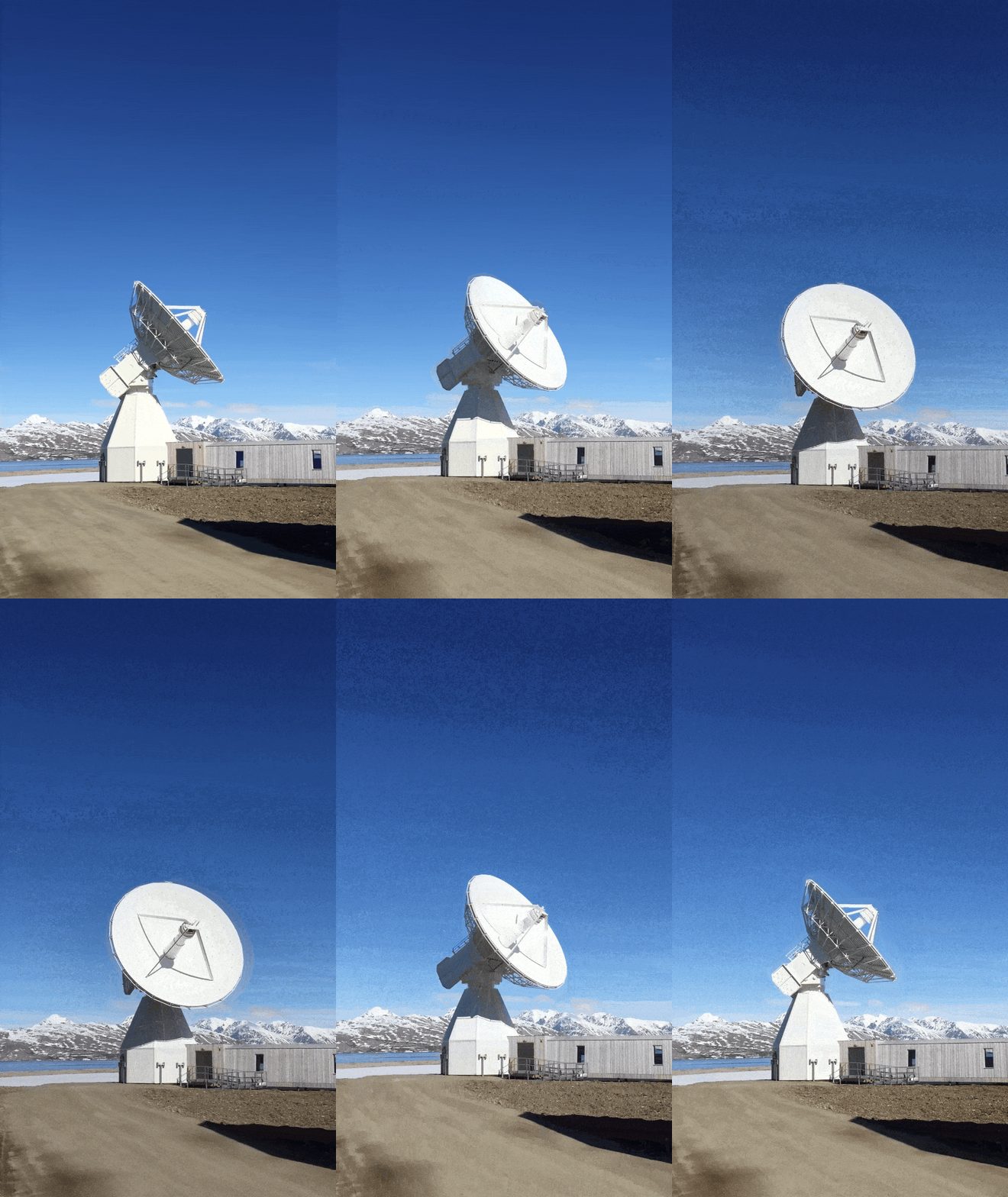
The VLBI network we use for our job. You can use your mouse to zoom on each telescope. Some antennas do not exist anymore, so dont be scared if you find that some places are empty. The green antennas are those of the legacy network observing at a frequency of 8 GHz. The pink ones are the newly deployed so-called VGOS antennas, smaller but faster. On the right, the VGOS antenna at Ny Ålesund, Svalbard, photographed in 2018 by the author.
VLBI was designed initially in the 1960s to image newly discovered objects called `quasar' which is the contraction of quasi-star. The wording quasi-star was propsoed because, at the time of their discovery, quasars had the aspect of a star when looked through optical telescopes. However, the visual aspect is the only property they share with stars: spectroscopy revealed what they are actually. Quasars are the most distant and most luminous objects known in the universe. They are, grossly speaking, galaxies with a very bright center (in comparison, the traditional vision of a galaxy, like Andromeda, is a large, bright disk). Their core is, thus, very active, formed by a supermassive black hole (say, a billion of Solar masses, or a 1 with 40 zeroes kilogrammes) around which rotates a disk of hot gas. The gas, which is ionized, that is to say made of charged particles, is falling onto the black hole that `eats' it slowly. As the gas is heated by the friction, it becomes bright with a ultra-violet, blue radiation. The very rapid rotation of the gas close to the black hole creates a very strong magnetic field whose magnetic lines escape perpendicularly to the disk, along the rotation axis of the system. Some charged particles are strongly accelerated by the magnetic field and escape toward the exterior along the magnetic lines, forming a bright jet of plasma (ionized matter) traveling at vertiginous speeds close to the speed of light. When the jet is strongly inclined in our direction, the relativity makes it much brighter (Doppler relativistic beaming) and gives us the impression that it travels at speed much higher than the speed of light (this is called superluminal motion). The relativisitic jet is a strong emitter of radio waves and that is why quasars are also known as radio galaxies (not all galaxies are radio galaxies).
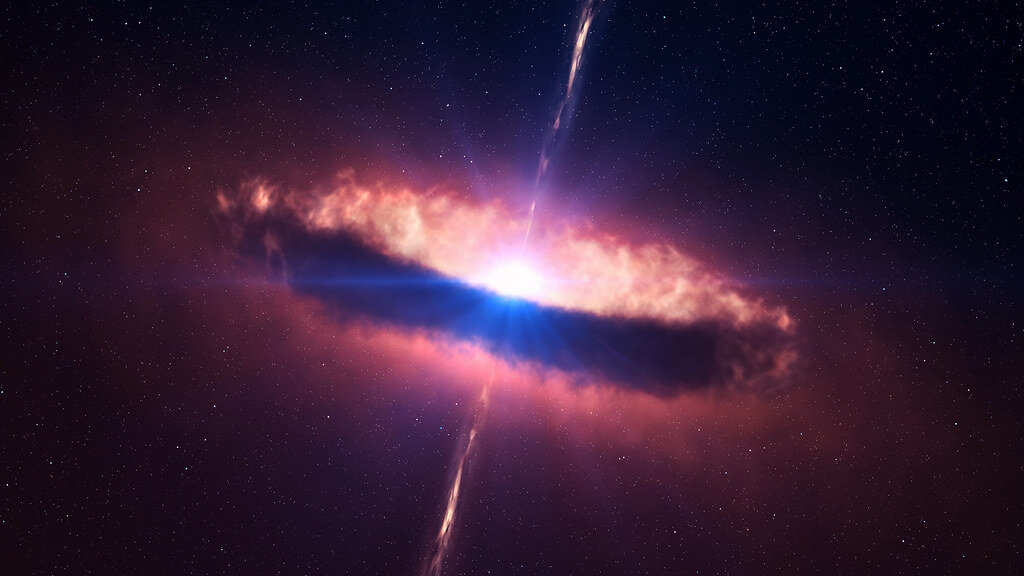
An artist view of a quasar with its rotating disk of gas rounded by a dust torus and its superluminal jet pointing perpendicularly to the disk.
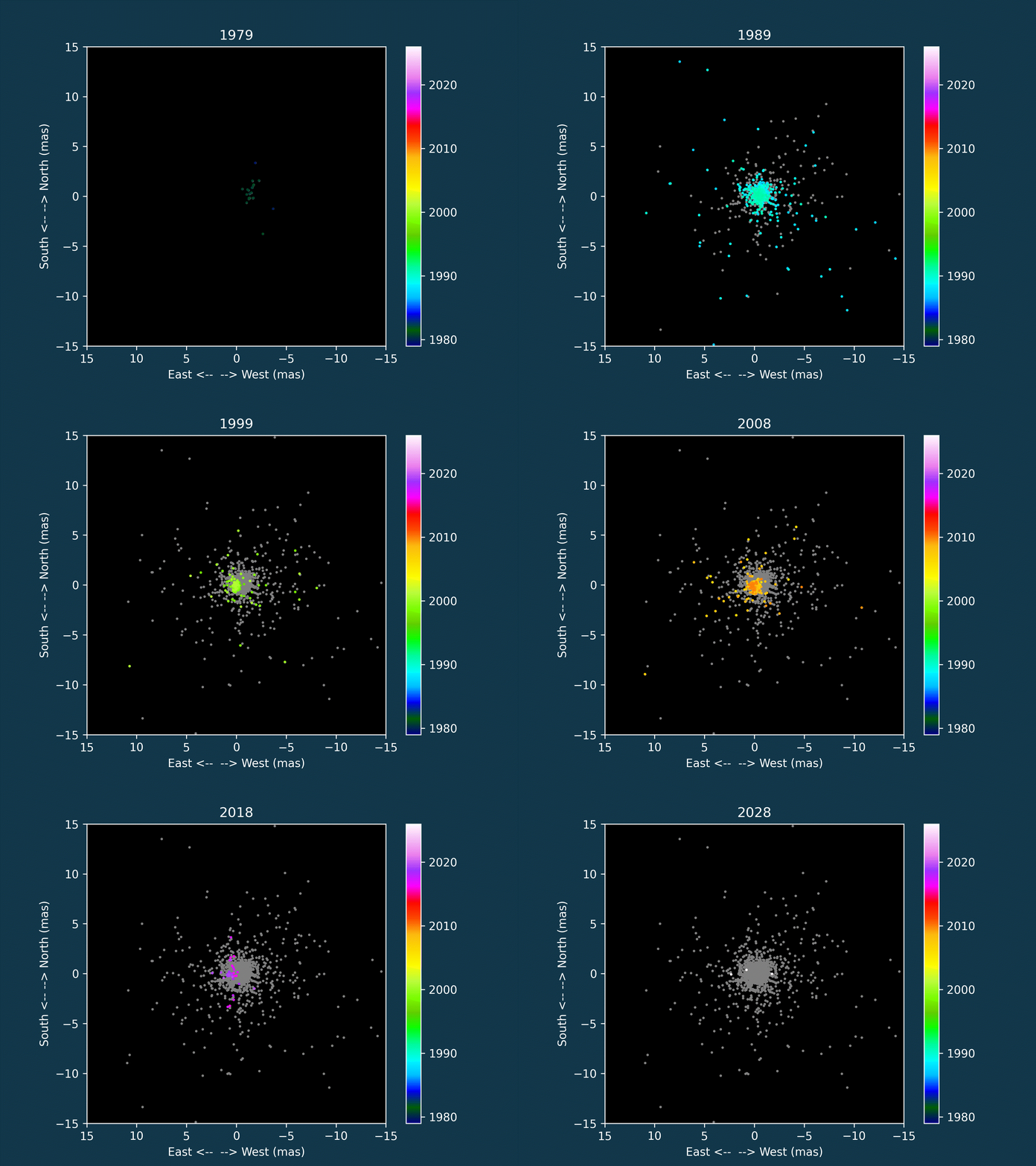
Our VLBI view of the quasar 4C 39.25: each dot is the position of the brightest point of the relativistic jet determined by VLBI around the mean position which is at the center of the map. The color indicates the epoch along 40 years of observations. As time elapses, the position of the brightest point is slowly migrating to the left as the black hole expulses the matter in this direction. VLBI imaging of 4C 39.25 can be seen from the American very long baseline array observations. The unit is the millisecond of arc (mas). At the distance of this quasar, one mas represents about 20 light-years (a 2 with 14 zeroes km).
On the pictures above, one can wonder about the sizes. The size of the black hole itself, i.e., the radius of the event horizon, is already much larger than the radius of the Earth orbit about the Sun. Then, the size of the disk and the length of the observed part of the inner jet (what we see on the artist view) is or several tens of light-years, that is the distance between us and some of the closest stars. These are enormous distances, as usual in astronomy. As an exercise, just take the position recorded in the 1990s. Counted along the horizontal axis, it is about -2 mas. Next, take the position in 2020: it is +1 mas along the same axis. The position has moved from West to East of about 3 mas in 30 years, that is 0.1 mas per year. As we said in the caption of the image, because this object is distant by more than a billion light-years, one mas on the map is equivalent to about 20 light-years. If, in one year, the recorded position moved by 0.1 mas, this is equivalent to moving by two light-years. In one year, it moves by two light-years: said differently, it moves at two times the speed of light! This is an example of superluminal jets. Remember this is an apparent speed due to relativity, not a real speed.
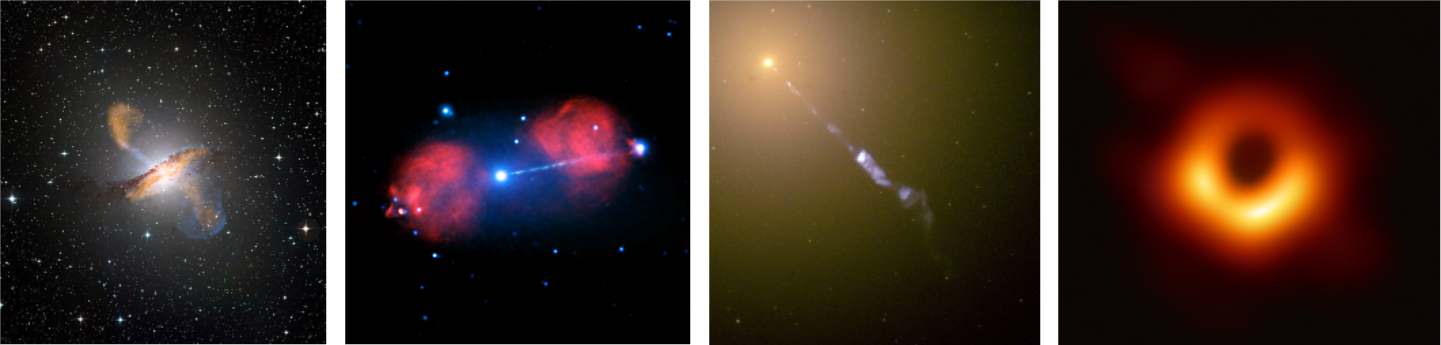
The first three images display three radio galaxies sufficiently close to us to be comfortably imaged by telescopes (not VLBI). From left to right: The lenticular galaxy Centarus A pictured by the European Southern Observatory; A composite image of the radio galaxy Pictor A made by the X-ray satellite Chandra (NASA) and the Australian radio telescope array; The supergiant elliptical galaxy M87 and its relativistic jet photographed by the Hubble Space Telescope. The rightmost image is the first-ever direct image of a black hole: the shadow and the ring of the supermassive black hole at the center of M87, imaged by the Event Horizon Telescope (EHT) VLBI network (2019). The ring of light around the shadow is due to the gravitationally bent image of the accretion disk. Such feature was nicely represented in Chris Nolan's Interstellar movie (2014) when the characters approach the giant black hole Gargantua. Capturing the image of a black hole remains one of the greatest scientific achievements of all times.
Quasars are therefore very violent objects. But they are also very far: several millions to billions light-years. As they are far, they appear very small, like stars. As they are far, again, they appear motionless on the celestial sphere. They can constitute very stable reference points, exactly as, in the past, stars were taken by travelers as reference points to guide them in the night. That is why, for more than forty years, VLBI has been used to build the `celestial reference frame', an ensemble of thousands of quasars whose coordinates on the celestial sphere are determined with a defying accuracy of few microarseconds. Thanks to this celestial frame, VLBI can also measure how the Earth is oriented with respect to the distant universe, and, thereby, measures how the Earth rotates. And, last but not least, once the position quasars are very well known, once the Earth orientation is very well known, then VLBI can measure the position of the radio telescopes at the surface of the Earth. As you know probably, nothing is fixed at the surface of our planet: plate motion drives each of us at few centimeter per year in different directions. Thanks to a NASA observing campaign in the 1980s, VLBI allowed a precise measurement of the plate motion, for the first time. Today, everyday, radio telescopes are observing quasars. Even during the day light, even when it rains. Because radio waves do not need night or clear sky to be captured. Everyday, these observations are treated by astronomers and their computers to determine a wide ensemble of products, going from the position of the quasars to the position of the antennas, including the Earth's rotation speed and the direction of the Earth rotation axis. The ensemble of products feeds scientific domains ranging from astrophysics to geophysics.
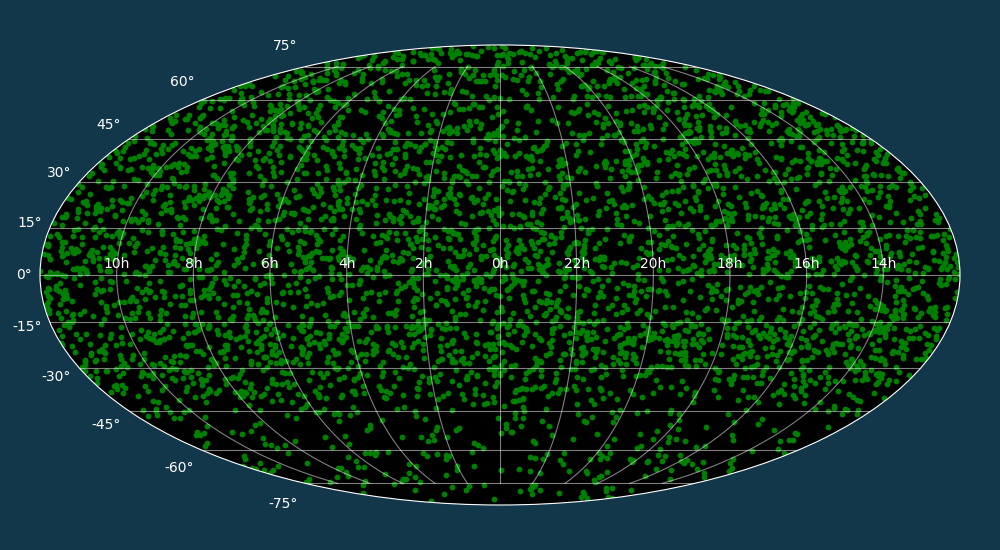
The International Celestial Reference Frame: each dot is a quasar. If you count, you should find 4536 quasars.
The principal of so-called `geodetic VLBI' is quite simple: the antenna A receives the radio wave emmited by the quasar a little before the antenna B, simply because it is a little bit closer. The `delay' of reception in B is given in the triangle ABC by the ratio of BC to the speed of light. Mathematically speaking, the distance BC depends on the length of AB (called the baseline) and the relative orientation of AB and the direction of the quasar in the sky. You can reproduce the drawing on a sheet of paper and convince yourself that, if you change the position of the quasar in the sky, the delay will change. Seamilingly, if you change the position of the telescopes on the Earth, the delay will change. And finally, if you change the orientation of the Earth with respect to the sky, the delay will change. The job of the astronomer (ours, for instance, here at Paris Observatory) is the following: scheduling observations of quasars with the VLBI network, measuring the delays of reception between radio telescopes and, based on the values of these delays, solve for positions of quasars, Earth orientation and rotation speed, positions of telescopes plus some additional physical quantities relevant to the atmosphere and the atomic clocks that are used as time markers in each telescope. Yes, this is feasible, and very precisely. For example, we determine the positions of the telescopes with a precision better than a centimeter.
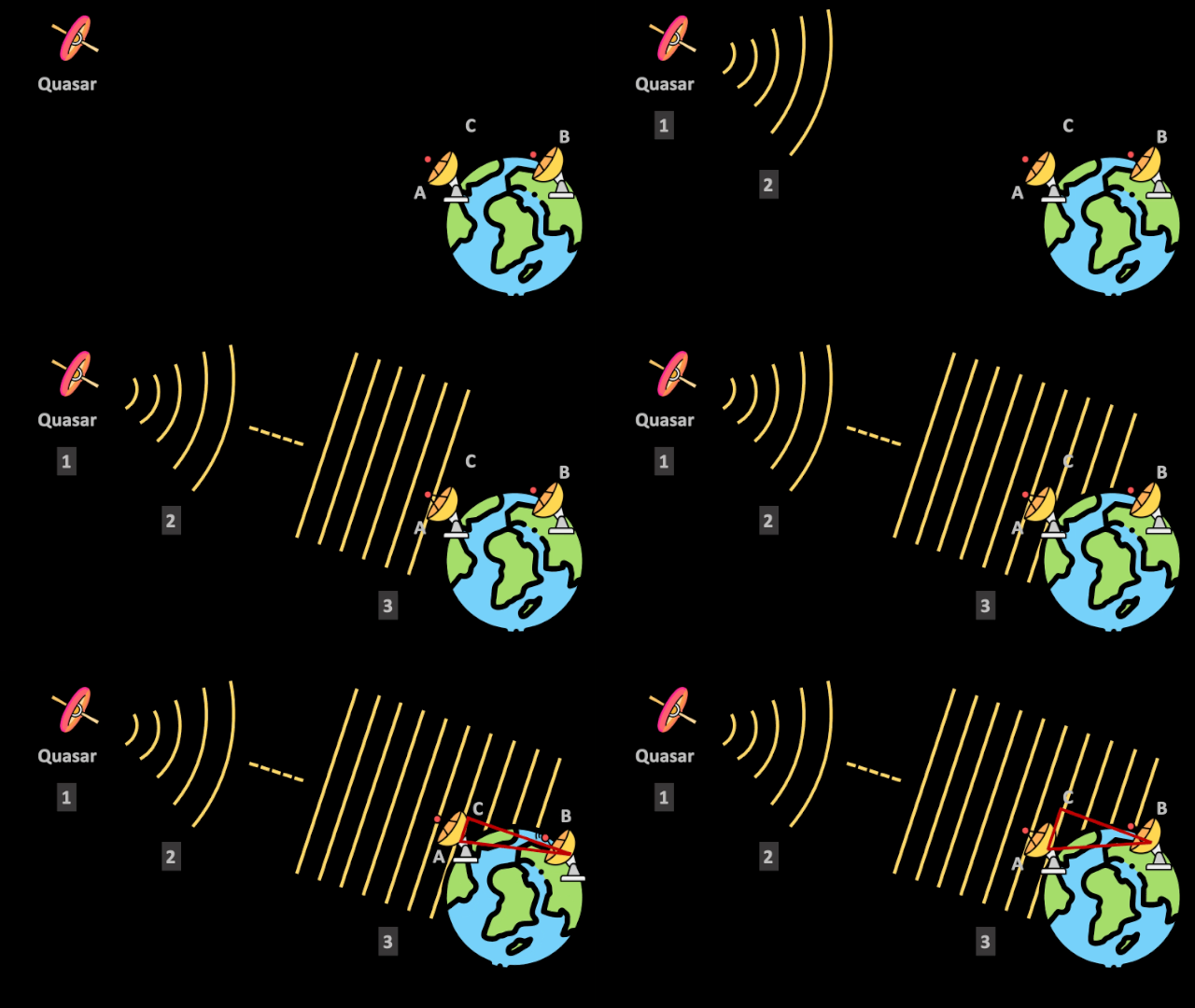
The principle of VLBI. (1) The quasar emits light. (2) The light propagates in every direction. (3) After a travel of millions to billions of years, the light arrives in the vicinity of the Earth and can be captured, first, by the radio telescope A and then, a little bit later, by the radio telescope B. That's it: the time delay of reception between the two antennas, proportional to the length of the segment CB, depends on the relative orientation of the segment AB and the quasar.
The Paris geodetic VLBI center is a component of the International VLBI Service (IVS) hosted by the NASA. The data treated and produced at the Paris geodetic VLBI center have several destinations. First, they are used directly by scientists at Paris Observatory and elsewhere in France and in the world. Scientific projects linked to these data are, for example, the study of the Earth rotation to understand the role of the core. Moreover, though quasars have definitely a leading role in space geodesy, they remain mysterious objects for astrophysicists with a number of unsolved questions. Thus, numerous studies led in our team are relevant to the characterization of the quasar population through astrometric and photometric indicators that allow us to unveil the emission mechanisms in the inner jet and the disk. Second, the data produced at the Paris geodetic VLBI center are sent back to the data center of the IVS and to the International Earth Rotation Service (IERS) for being combined with other VLBI data and data from other geodetic techniques (GPS, Laser ranging) in order to produce the daily standard reference Earth rotation. There is a redundancy of geodetic VLBI centers in the world in order to make sure that every day, at least one center is operational.